


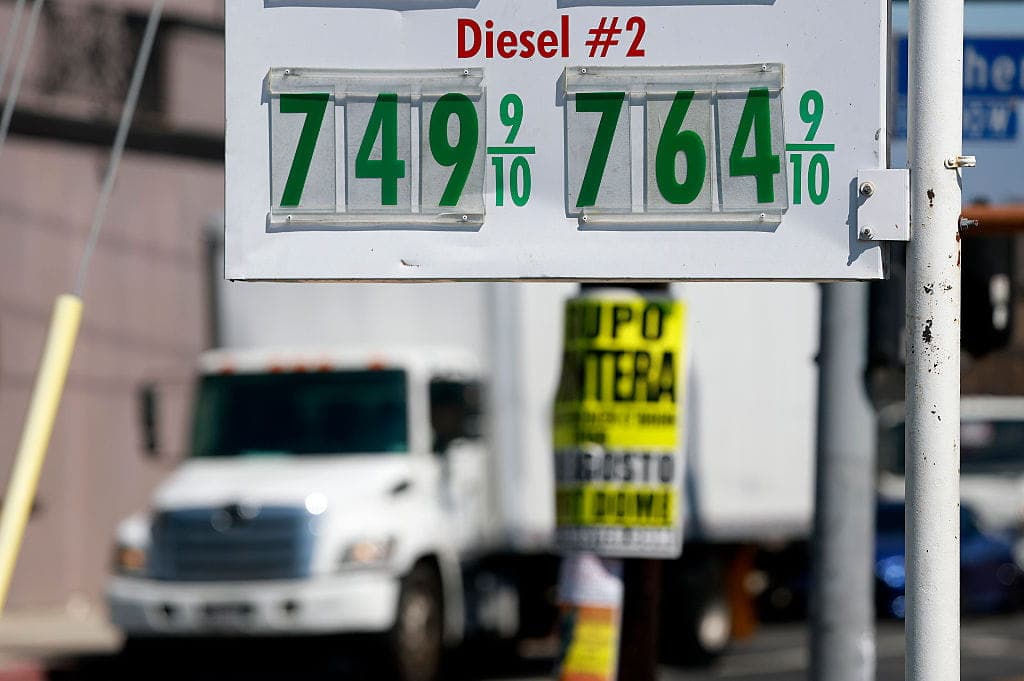

The war in Iran, now in its seventh month, is upending global energy markets. With no end in sight, the geopolitical situation looks bleak, and this may not bode well for inflation going forward. Crude oil – both the US and global benchmarks – is above $100. Gasoline is also firmly above $4 per gallon and has risen almost 30 cents in the last month. But diesel prices could be the economy’s widow-maker in the coming months.
Revving Up Diesel Prices
Diesel prices set a fresh record high on Sept. 14, topping $6.23 per gallon, according to the American Automobile Association (AAA). A year ago, a gallon of diesel was just $3.70.
This is bad news for an international economy already facing the realities of an oil supply shock. Diesel plays a role in almost everything we do in the physical world every day. But one item is more exposed to the fuel than others: food.
Commercial trucks consume hundreds of gallons every week, making fuel one of the largest expenses for trucking firms that ship plums, prunes, and Pop-Tarts. The industry has already faced other headwinds, including a labor shortage, so higher diesel costs will be another challenge truckers face in the coming months.


Free with the Daily Briefing
85EssaysUnravel the Constitution
Hamilton, Madison & Jay’s complete case for America, free and searchable in the Publius Reader.
Free with the Daily Briefing. Unsubscribe anytime.
At least food inflation has been tame thus far, with supermarket prices flat in August.
Conditions could deteriorate further as diesel markets enter one of the year's most volatile periods, with supply tightening and flows disrupted. What's more, US diesel inventories have fallen sharply since the winter, from more than 129 million barrels to around 106 million barrels, according to the Energy Information Administration (EIA). To be fair, domestic stockpiles have been in gradual decline since 2021, but given everything unfolding across the globe, it will be difficult if US supplies slide below 100 million barrels.
Ultimately, $6 could be the norm for a while, and this could filter through the broader economy in the form of higher inflation. So far, structural inflation is stable, but that may not hold heading into 2027. Does this mean the Federal Reserve and other major central banks will raise interest rates? Well, unless their printing presses can produce more crude oil, gasoline, and diesel, a rate hike might not be enough to cushion the blows of upended global energy markets.
Blame Ukraine?
The Iran war has been the main driver of surging oil prices. The Strait of Hormuz has been at the center of Middle East tensions, with oil tanker traffic cut in half.
While Gulf countries are expanding pipeline capacity or building new pipelines to bypass the narrow waterway, these efforts will not provide short-term relief. Additionally, Saudi Arabia announced on Sept. 11 that it shut down a key pipeline as a “precautionary measure” amid attacks.

Tehran has dominated foreign policy headlines this year, but the conflict in Eastern Europe has worsened international diesel markets. This past summer, Ukraine has been bolstering its attacks on Russia’s refining infrastructure, forcing the Kremlin to ban diesel exports through the end of September. The intensification of tit-for-tat strikes has removed the third- or fourth-largest refining market from the equation, exacerbating price pressures.
This has caught President Donald Trump's attention. During his weekend visit to Ireland, Trump urged Ukraine to stop hitting Russian diesel and instead focus on legitimate targets. He had a message for Ukrainian President Volodymyr Zelensky: "Stop knocking out diesel fuel in Russia."
"This isn’t done by the Middle East. This is done by what’s happening with Russia and Ukraine,” Trump said. “Don’t hit diesel fuel, because that’s hurting the world. We don’t want him to hit diesel fuel."
Second Order Effects
Since the outbreak of war in the Middle East, economists have been waiting for second-order effects of surging energy prices. Economic observers can see the spike in fuel prices across headline Consumer Price Index (CPI) and Producer Price Index (PPI) data. However, they have yet to seep into underlying inflation numbers, also known as core CPI or PPI. But how much longer can this last before it hits consumers’ pocketbooks throughout the entire marketplace?


.jpg&w=1920&q=75)