


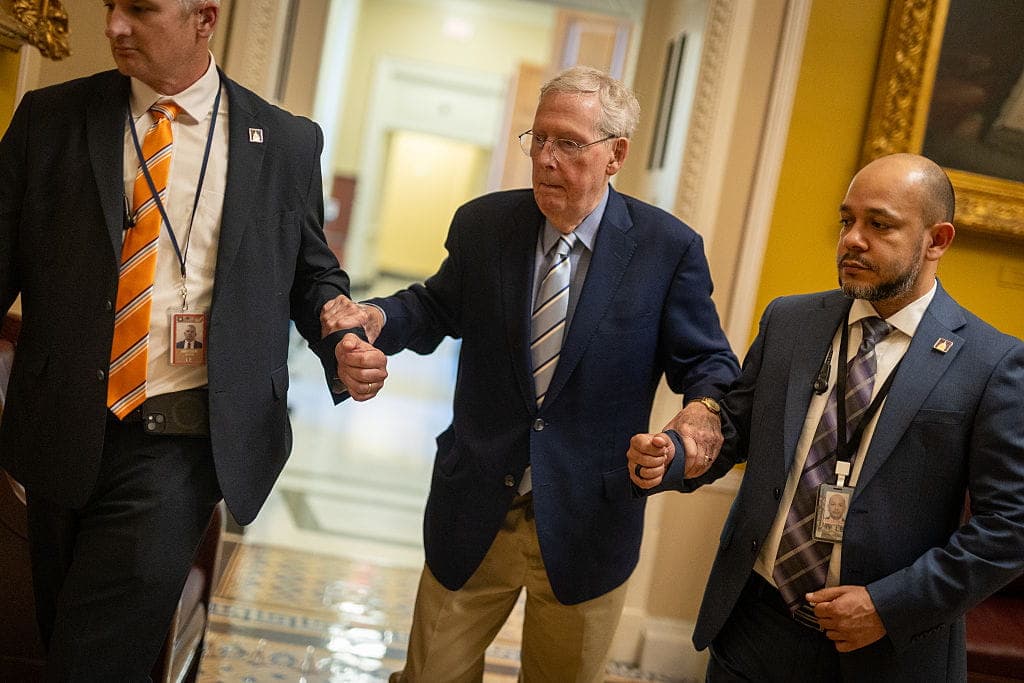

Congress has an aging problem. The average age of Congress has steadily risen over the years. Currently, it’s around 57 for the House and 64 for the Senate. But the oldest members of Congress – who are also the longest serving – really expose the issue.
Mitch McConnell and an Aging Congress
Sen. Mitch McConnell (R-KY) spurred yet another debate on congressional age with his return to the Capitol this week. The 84-year-old was missing from both the Senate and the public eye for three months following a fall, a bout with pneumonia, and a couple months of rehabilitation.


Free with the Daily Briefing
85EssaysUnravel the Constitution
Hamilton, Madison & Jay’s complete case for America, free and searchable in the Publius Reader.
Free with the Daily Briefing. Unsubscribe anytime.
Sen. Chuck Grassley (R-IA) is the oldest and longest-serving member of Congress. At 92, he has held office for more than 50 years. The Dean of the House, Rep. Hal Rogers (R-KY), has served for 45 years and is 88 years old. Rep. Eleanor Holmes Norton (D-DC) is the oldest female House member at 89 and has been in Congress for about 35 years. Rep. Maxine Waters (D-CA) and Sen. Bernie Sanders (I-VT) are both in their 80s as well and have served for about 35 years. These people have been in Congress longer than some of their colleagues have even been alive.
Can an 80- or 90-year-old still fulfil the duties of a lawmaker? That’s the question on many minds these days, given the health issues some of these people have had. And they’re just the survivors; six members of the 119th Congress have died in office this term, and four died in the 118th.
A Modern Problem
The aging government is a modern issue – and it isn’t limited to Congress. When this nation was founded, the Founding Fathers were almost all in their 30s, 40s, and 50s. Benjamin Franklin was the oldest signer of the Declaration at 70, and he was 81 when the Constitution was drafted. But he was the outlier. George Washington, who commanded the Continental Army, was 44 in 1776 for the Declaration of Independence – though he didn’t sign it – and 55 when he presided over the Constitutional Convention. And he was 57 when he became the first president.
John Adams was 40 and 51, respectively, for the Declaration and for the signing of the Constitution (although he did not actually sign as he was serving as the US Minister overseas in Great Britain at the time), and became the second president at age 61. Thomas Jefferson was just 33 when he drafted the Declaration. James Madison, often called the Father of the Constitution, was 36 in 1787.
Thomas Lynch Jr. and Edward Rutledge were the youngest signers of the Declaration at age 26, and Jonathan Dayton of New Jersey was the youngest delegate at the Constitutional Convention, also 26. The average age of signers was 45 for the Declaration and 42 for the Constitution.
William Henry Harrison was 68 when he was inaugurated in 1841, making him the oldest of America's first nine presidents. Then came James Buchanan in 1857, aged 65. Flash forward to Donald Trump’s first inauguration at age 70, Joe Biden’s at 78, and Donald Trump’s second at 78. The next oldest president was Ronald Reagan at 69. His age was controversial at the time, and he was younger leaving office than Trump going into his second term or Biden at his only inauguration.

Does this modern problem demand a modern answer? Some say it does, advocating for an age cap after which politicians simply don’t qualify for service anymore and term limits to prevent people from getting too cushy in office. Whether such a change is right or wrong, however, and whether it happens are two entirely different – and perhaps unrelated – issues.
Maybe lifelong lawmakers are a wealth of wisdom and legislative knowledge, but perhaps they shouldn’t get too comfortable in the lifestyle or work past their prime. Either way, term limits and age restrictions aren’t likely to happen any time soon. There are many in Congress – across both houses and both parties – who say it’s time for a change, but the older lawmakers get, the less likely they are to vote for their own forced retirement.


.jpg&w=1920&q=75)